
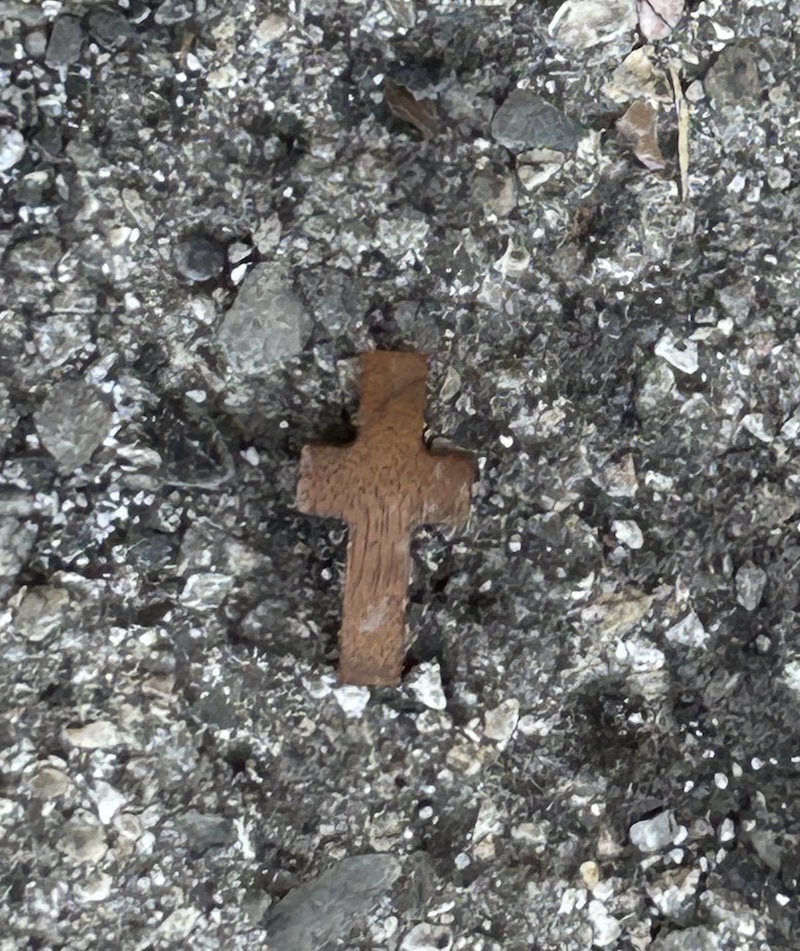
The other day, on my way to a meeting, I parked my car, got out, and saw on the ground a small wooden cross. It was lying there on the pavement. I almost picked it up – it seemed like maybe the universe was giving me a symbol of my faith, perhaps some reassurance. In the end, I decided to leave it there for someone else to find – maybe someone who needed encouragement more than I did that day.
After the meeting, as I drove away, I thought about that cross and what it could mean for the next person who found it.
Maybe someone like me, a Christian, would find that cross and be reminded to carry their faith with them into their next meeting.
*****
The crosses in churches and around our necks and on the bumpers of cars carry lots of meanings for the people who see them.
We know that at the time of Jesus’ life and death, crosses were instruments of death. Romans used tall wooden crosses to execute criminals they found especially heinous. The worst crimes were challenges to their power. Treason, rebellion, murder, desertion from the army. These were all offenses punishable by crucifixion.
Not only was the execution painful, it was public. The naked bodies of the offenders were on display as they died and long after as a warning to others: If you offend, this will happen to you. It was intentionally humiliating.
When Jesus’ disciples and his first followers thought of the cross they thought of victory, but their image was not gold and ornate as our crosses often are. In fact, among early Christians, the cross was not even the main symbol of their faith. They used a fish/icthus that we sometimes see on bumper stickers or an anchor as symbols.
Early Christians were mocked for their association with the cross, it was a shameful symbol of Roman power and execution. It was that way for more than 200 years.
Then the Emperor Constantine came along. After he had a vision that promised victory in battle if his army used the symbol of the cross on their shields, helmets, and standards, it became a symbol not of weakness but of political and military power.
There was a complete turnaround. The cross started appearing on coins and monuments. Once a symbol of persecution, it came to represent victory and protection. It was not only aligned with the power of God, it was also linked to the power of earthly empire.
Things were never the same again. Since that time, Christians have used the cross, a symbol of salvation. And we have also used the cross to oppress and terrorize people. The instrument once used to execute Christ has, since the time of Constantine, been used by Christ’s followers to persecute perceived enemies, including fellow believers.
*****
I thought about this when I reflected on the cross I found in the parking lot. What if whoever found that cross was not a Christian, but someone who had been hurt by cross-bearing people? Historically, this has especially been the case for Jews. For centuries a false theology (that Jews were “Christ killers) has led to massacres of Jews individually and as whole communities. Good Friday became a dangerous time for Jews, a time when Christians targeted them with harassment and violence.
Along the way, Muslims were added to the target list as enemies of the cross. Like Jews, they were victims of the Crusades and Inquisitions.
We might be tempted to think that the cross is no longer abused in this way. We might hope that the lessons of past mistakes would encourage Christians to remember that the cross should rightly be a symbol of humble service and sacrifice.
But sadly, the cross has been and still is used to stand for other values…
In the 20th century, people who claimed Christian faith and heritage burned crosses to intimidate and threaten African Americans and other marginalized groups. This practice is still used as a tool of hatred today.
Some Christians are using crosses to shame and vilify our LGBTQ siblings – and to denounce other Christians who disagree with their interpretations of scripture and tradition.
There are many today who feel more traumatized by the cross than saved by it.
*****
I wonder what finding a small wooden cross in a parking lot would mean to our Jewish and Muslim neighbors?
I wonder what it would mean to someone who had no particular faith tradition?
I wonder what it would mean to someone who had faced the cross as a threat?
I wonder how someone might feel finding that cross if they were a Christian who had been hurt by the church?
Today, more than most days, is a time to reflect on the cross and what it means.
What it meant to Jesus and to those who saw him hanging on it.
What it meant to his early followers who met in secret because of their devotion to a cross-shaped faith.
What it means today to people who wonder if God loves them.
Today is a good day to remember that the cross was the place where God met us in our human suffering in the body of Jesus Christ – and did so not to shame us or vilify us but to love and save us.
The cross is our reminder that God was and still is with us, even in the depths of physical, emotional, and spiritual pain. The cross is God’s promise that there is resurrection on the other side.
Based on a sermon preached at St. Elizabeth’s Episcopal Church, Buda, Texas 4.3.26